The Letter Before the Novel: Stories in Pieces
Stories in pieces use letters, records, and other documents to make readers assemble a narrative while each fragment reveals only part of the whole.
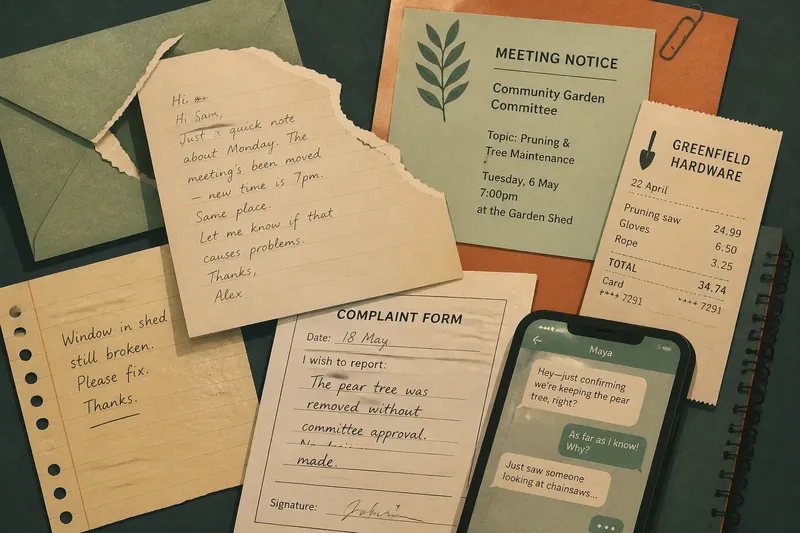
A letter arrives with its corner torn away, and the first thing the reader notices is what cannot be read. Stories in pieces use letters and other standalone documents to make that kind of absence part of the narrative: the reader gathers a story from materials that were made for purposes other than telling it. The form is sometimes called epistolary, especially when letters dominate, but it can also include notices, transcripts, forms, diaries, and private messages.
What makes a document a narrative fragment?
A document is a fragment when it carries information about a larger story without presenting that story in full. A letter may say that a meeting has been moved, while leaving the reason unstated. A receipt may establish that someone was in a particular place, but not explain why. The narrative develops in the space between the document’s immediate purpose and the reader’s larger question.
This is different from simply placing a letter inside an otherwise conventional narrative. If a narrator explains what the letter means before or after quoting it, the document may serve as illustration. In a document-based story, the documents themselves do much of the work: readers infer relationships, sequence, and change by comparing them.
The form asks a simple question of every piece: why does this document exist? A note written to comfort someone sounds different from a formal complaint written to create a record. Its intended recipient, practical purpose, and limits shape what it can reveal. A document’s omissions are not automatically mysterious; they become meaningful when the story gives readers reason to notice them.
Why can fragments feel more revealing than a continuous account?
A continuous narrator can report what several characters think and know. A document usually cannot. Its writer may misunderstand events, conceal a motive, address only one reader, or assume that shared context makes explanation unnecessary. The reader therefore meets a person through choices of wording and emphasis rather than through direct access to an all-knowing account.
That limitation can make a small detail carry several kinds of information. A tenant’s note might carefully list a damaged window but never mention the argument that preceded it. The list gives practical evidence, while its precision may also suggest that the writer expects to be challenged. Neither interpretation needs to be declared as fact; the document offers grounds for the reader to consider both.
Documents also preserve different kinds of authority. A signed form may be reliable evidence that someone made a statement, but not that the statement was true. A private letter may be candid about one matter and evasive about another. Keeping those distinctions clear prevents a story from treating paperwork as an objective answer machine.
How do writers choose which documents belong?
Start with the larger change the reader should be able to trace. Perhaps neighbors who once cooperated become suspicious of one another, or a family’s shared account of an event gradually separates into conflicting versions. Then select documents that register distinct points in that change. The aim is not to collect every plausible artifact, but to give each one a reason to be read.
- Give each piece a job. It might introduce a person, complicate a claim, shift the timeline, or show a relationship changing.
- Give it a believable audience. A private journal, a public announcement, and a message to a sibling should not carry the same assumptions.
- Let the form affect the voice. A printed notice may sound impersonal because of its function; a text exchange may rely on shorthand and shared references.
- Leave some context outside the document. Readers should have enough to make a useful inference, not so much that the artifact becomes a disguised summary.
- Check what the writer could know. A document should not report events its author could not witness or learn about through a plausible source.
Say you are writing about a community garden whose members dispute who agreed to remove an old pear tree. You might use a meeting notice that announces a pruning discussion, a member’s email that assumes the tree will remain, and a later complaint that refers to a decision no one recalls making. The documents give readers a trail of changing claims; they do not need to spell out a secret plot. Each piece earns its place because it alters what the reader thinks the group understood.
What is not worth the effort is inventing elaborate stationery, stamps, or archival decoration before the documents have narrative purposes. A convincing-looking envelope cannot compensate for a piece that repeats information or has no reason to exist. Choose the paper details only when they affect how the document is read or handled.
How can the order create a story?
Chronology is one option, not a requirement. Arranging documents by date can make gradual change easy to follow, while beginning with a later artifact can establish a question that earlier pieces then revise. A purposeful sequence controls when readers receive evidence and how long they hold competing interpretations.
Keep two orders in view: the order in which events happened and the order in which the reader encounters their records. A document created later may discuss an earlier event, and its writer may have reasons to reshape that event. A date line can establish when an artifact was made, but it cannot by itself establish when every claim in it became true.
Useful transitions often come from a specific overlap. One letter names a key that the next document lists as missing. A form repeats a phrase from an earlier complaint but assigns it a different meaning. Such connections help fragments accumulate into a narrative without requiring a narrator to explain every link.
As you arrange the pieces, ask what the reader can reasonably infer at each point. If the intended inference depends on a fact that has not appeared, the sequence may need another document or a clearer clue. If several pieces establish the same fact without adding a new perspective, one may be unnecessary.
What do readers ask about stories told through documents?
Are letters and epistolary stories the same thing?
Epistolary usually describes a story told substantially through letters, including exchanges between correspondents. A story made from documents may use letters alongside records, announcements, transcripts, or other forms. The distinction is useful, but the important craft question is whether each piece contributes to the narrative.
Can readers trust a document in a story?
They can trust that the document represents what its writer chose to record, if the story gives them reason to accept that it is authentic within the fiction. They cannot automatically trust the writer’s memory, interpretation, or honesty. A strong sequence lets readers compare accounts rather than relying on a label such as “official.”
How much background should each fragment include?
Include the context the intended reader would need, then let the rest emerge across the sequence. Real writers often assume shared knowledge, so an unexplained reference can feel natural when its meaning becomes clear later. If readers cannot tell who is speaking or what the document is for, the omission is likely obstructive rather than suggestive.
Does every document need a different format?
No. A small set of recurring forms can make contrasts more legible than a parade of unrelated artifacts. Vary the format when a change in audience, purpose, or access to information gives the story a reason to do so.
How can a document sequence stay coherent without flattening ambiguity?
Coherence comes from relationships among pieces, not from making every account agree. Readers need stable bearings: who created an item, roughly when it belongs, and how it entered the record. Within those bearings, contradictions can remain unresolved if they point to a meaningful difference in knowledge or motive.
Use small, consistent signals to orient the reader. A heading might identify the author and recipient; a short editorial note might explain that an item was found among papers or copied from a public notice. These aids should clarify the artifact’s status without interpreting its emotional meaning for the reader. If a document’s source is uncertain, state that uncertainty plainly rather than disguising it as a puzzle.
Voice needs equal care. Each writer should sound shaped by a particular relationship and purpose, not merely by a different collection of verbal quirks. One person might use complete, cautious sentences in a message to a committee but write abruptly in a private note. That contrast feels earned when the audience changes; random stylistic flourishes do not.
Revision can test whether the fragments work as both objects and narrative turns. Read them first in sequence, noting what changes in your understanding after each one. Then read each document alone: does it have a plausible reason to exist, a recognizable writer, and enough context for its intended recipient? A fragment that fails alone may need a clearer situation; one that adds nothing in sequence may need to be cut or reshaped.
Stories in pieces succeed when readers do more than collect facts: they revise their understanding as one record presses against another. The letter, form, or notice need not disclose the whole story. It needs to leave a specific trace that the next fragment can answer, challenge, or make newly difficult to interpret.