The Clue That Explains Too Much
Revise an over-explained mystery clue by separating observation from interpretation, then give readers room to infer without losing the trail.
You reread a mystery scene and notice that the detective has already explained the clue before the reader can turn it over. The muddy boot print points to the stable, the detective says; the stable hand must have crossed the garden, and therefore he had access to the missing key. The clue that explains too much can make a reader feel less like a partner in solving the mystery and more like an audience being briefed.
That does not mean every clue should be obscure. A useful clue gives the reader something definite to notice, while holding back the conclusion that connects it to the larger case. A revision routine spread across a week can help you find that balance without weakening the trail or making the detective seem coy.
What makes a clue explain too much?
A clue becomes over-explicit when the scene supplies both the evidence and its meaning in one breath. The narrator points to a detail, explains what it signifies, and often adds a second line confirming why it matters. The reader has no meaningful interpretive work left to do.
Consider the difference between “A strip of blue wool clung to the broken latch” and “The blue wool proved that Mara had forced the latch with her coat.” The first is an observation. The second assigns a source, an action, and a person, though the scene may not have established enough to support any of those conclusions.
Sometimes that certainty is appropriate. A character may recognize a distinctive thread, or the plot may need the reader to understand a deduction immediately. The revision question is not whether explanation is bad; it is whether the explanation arrives before the reader has a fair chance to notice, wonder, and connect.
How should you start the week?
On the first day, read the mystery as a reader rather than as its author. Mark every clue and the sentence that interprets it. Include small details that later become meaningful, as well as explicit evidence such as a receipt, a stain, a changed lock, or a witness’s oddly precise wording.
Next to each mark, note what the reader can reasonably know at that exact point. Keep this separate from what you know because you have the full outline. That distinction matters: an author’s knowledge of the culprit can make a faint detail feel obvious, even when a first-time reader has not been given the context to understand it.
On the second day, sort the marked passages into three groups:
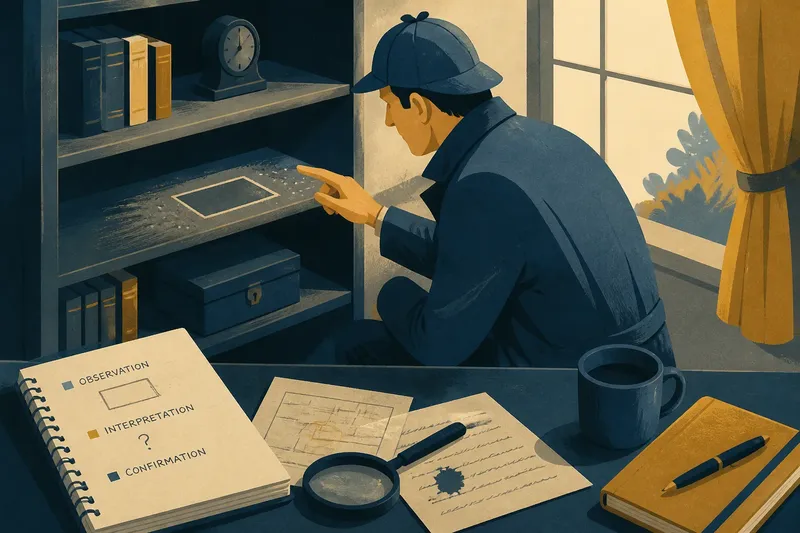
- Observation: A concrete detail appears, but its meaning remains open.
- Interpretation: A character or narrator proposes what the detail means.
- Confirmation: Later evidence supports, changes, or rules out that interpretation.
One passage can contain all three. The point is to see where the draft collapses them together. If every clue is followed immediately by interpretation and confirmation, the mystery may be giving away its reasoning in a steady stream, even if none of the individual sentences seems excessive on its own.
What should you check in each clue scene?
On the third day, inspect the scenes with the most important clues. Ask what the reader actually sees, hears, or learns; what the investigating character concludes; and what remains uncertain. A detail can be clear without its meaning being settled. In fact, clear evidence often makes a better puzzle because the reader can revisit it and form a different explanation.
Check whether the clue’s source is established. If a character says the handwriting belongs to the victim, the scene needs a reason that character can identify it. If the detective recognizes a chemical smell, the story needs a plausible basis for that knowledge. An unexplained leap is not an invitation to infer; it is missing support.
Then look for echoing explanation. A character may state a deduction, another character may restate it, and the narration may summarize it again. Choose the version that carries the most useful dramatic information. Keep another only if it adds a distinct response, complication, or consequence.
Also note whether the explanation changes the scene. A deduction that affects a search, damages trust, or sends the characters toward a new question may earn space. A paragraph that only translates a visible object into a conclusion may be doing work the scene can leave to the reader.
How can you revise without making clues cryptic?
On the fourth day, revise one clue at a time. Start by preserving the concrete evidence: the damp soil on a windowsill, the torn edge of a map, the untouched cup beside the desk. Remove or delay only the sentence that settles its meaning too soon. Then read the scene aloud and check whether the reader still knows what happened physically.
Say you have written a scene in which a detective finds a dry patch on a dusty shelf, announces that a small box was removed, and concludes that the housekeeper took it. You could retain the clean rectangle and let the detective ask who last dusted the room. The scene now supplies an observable change and a question, while the accusation waits for additional evidence. The expected effect is not that readers all reach the same answer, but that they have enough to consider the possibility themselves.
Do not replace a plain explanation with a fog of hints. A character who notices a detail should have a reason to notice it, and the prose should make the detail legible. If the reader cannot tell whether the mark is on the inside or outside of the window, uncertainty about the culprit may become uncertainty about the sentence.
Be careful with point of view, too. A close viewpoint can report what a character observes without naming the deduction the character has not yet made. But withholding a thought the character would naturally have, merely to protect a twist, can feel artificial. Let the character register the evidence; control what follows by giving the scene another immediate concern or by allowing a competing explanation to seem plausible.
When should the story explain the answer?
On the fifth day, review the passages where a clue is interpreted. Ask whether explanation belongs now, later, or nowhere. If the character must act on a provisional theory, let the story show that it is provisional. If the detail has already become clear through action and dialogue, another explanation may not be needed.
Readers need more guidance when a clue depends on specialized knowledge, a concealed timeline, or a distinction the story has not yet made visible. In those cases, clarity is a matter of fairness. You can provide the missing context before the deduction, or show why the character has the relevant expertise. Making the clue less explicit is not a substitute for making it understandable.
Readers need less guidance when the evidence is concrete, the relevant context is already present, and the inference follows from details they have seen. A short pause, a changed subject, or a character’s decision can give that inference room without adding a wink that tells readers they should be suspicious.
Which questions help during a clue revision?
How many times should a clue appear?
A clue may return when its meaning changes or a new piece of evidence gives it a different context. Repeating the same detail only to remind readers it matters can make the author’s hand too visible.
Should the detective explain every deduction?
No. Explain deductions that readers could not fairly follow, or that must shape the next action. Leave a supported inference unstated when the scene already gives readers the necessary pieces.
What if readers miss an important clue?
Check whether the clue is visible and memorable enough to be noticed, not whether it has been explained repeatedly. A character can encounter it again for a plot-based reason, or a later discovery can give the original detail new relevance.
Can a clue be misleading without being unfair?
Yes, if the evidence remains accurate while a character’s interpretation proves mistaken. A misleading clue should support more than one plausible reading at first, then become clearer as new information arrives.
How should you finish the week?
On the sixth day, read the revised sequence without consulting your notes. Pause at each clue and write down what you think it could mean before reading onward. If you cannot identify the evidence, the prose may need clarification; if the only possible answer is already spelled out, consider whether the interpretation can wait.
On the seventh day, make a continuity pass. Confirm that later discoveries still follow from the evidence you left on the page. Check that the detective does not suddenly rely on a detail the reader never encountered, and that an earlier ambiguity is eventually resolved or shown to have been a genuine false lead.
It is not worth trimming every explanatory sentence simply to make the prose seem clever. A clear explanation can create pace, establish a character’s expertise, or prevent a crucial action from feeling arbitrary. The useful edit is narrower: remove explanation that only repeats what the scene has already made available.
For a clue that explains too much, revision is less about hiding information than separating what happened from what it means. Keep the evidence tangible, make the character’s reasoning fair, and choose the moment when the story confirms a conclusion. That gives readers room to work without asking them to solve a puzzle from details they were never given.